


Key takeaways:
- Compounding interest can accelerate the achievement of your wealth growth goals by earning interest on the principal investment amount as well as any historical earnings.
- You can maximize your earning potential by investing early, investing often, and re-investing any returns.
- Leveraging private alternative investments, like real estate investment trusts (REITs), and combining them with registered savings accounts can boost the power of compounding with re-investment and tax efficiencies.
- Find answers to common questions about compounding in the FAQ section below.
Your money is the most valuable today than it will ever be. As Harvard Business School explains, money you have in hand today is at its peak value because it still holds its full potential of earning, it has not been depreciated by inflation, and is certain, unlike projected earnings. Capitalizing on that peak value by harnessing the investment superpower of compound interest, combined with leveraging private alternative investments—like private REITs—can supercharge the potential earning power of today’s money.
What is compound interest?
Compound interest is the cumulative amount of interest earned on both your original principal investment and any earnings previously added to it. Essentially, it’s a “growth on growth” effect that lets you earn money on the capital you have invested, as well as any earnings that same capital may have gained historically.
Compound interest vs. simple interest: Make your money work harder
Not all interest is created equal. Simple interest is only applied to the principal investment amounts, with no distributions or interest earnings re-invested, resulting in a slower, linear growth. Conversely, compound interest can accelerate your earnings over time, as it applies to both the principal interest amount and any historical earnings, thereby compounding your potential overall growth.
Let’s look at how the value of these different earning types compare, using an example of an initial $50,000 investment at an assumed 5% annual interest rate:
- Simple interest: You would earn $2,500 every year during the lifespan of your investment. At the end of five years, your investment would be worth $62,500—your initial $50,000 investment, plus the $12,500 in interest earned.
- Compound interest: By re-investing your earnings each year, your money would earn interest on interest. Over the same five-year period, your investment would be worth $63,814, an extra $1,314, just from compound annual growth working for you.
While the difference in earning potential may seem small over five years, the benefits of compound interest over time are clear, especially when you consider the growth that could be realized over decades and combine that with investments that offer historically consistent returns.
How to maximize compound interest
To truly maximize your earning potential with compound interest, there are three key variables you should consider when choosing your investments:
- Compounding frequency: Increasing the number of compounding periods, or the times during the investment lifecycle when interest is calculated and deposited back into your investment account, can, in turn, increase your compound interest earnings. For example, if the same 5% interest rate from the example above was compounded monthly instead of annually on your $50,000 investment, your investment would grow by 28.34% instead of 27.63%.
- Time in market: The longer you invest your money, the greater the earning potential of your investment. Going back to your $50,000 investment, after five years it would be worth $63,814, but after 15 years, it would be worth $103,946, a 107.9% increase from your initial investment.
- Amount invested: Increasing the amount of principal that you invest, even in small amounts, consistently over time, can exponentially increase the earnings on your investment. If you invested an additional $1,000 each month, on top of your initial investment of $50,000, after monthly compounding at 5% interest, in just five years your investment would be worth $132,174, 136% more than if you had just kept the principal amount the same.
As you can see, small adjustments to your investments can make a big impact on your overall earning potential.
How compounding works within a REIT
The real potential of compounding lies in funds that allow re-investment, like private real estate investment trusts (REITs). These powerful investment tools can allow you to harness the power of compounding, ensuring you are positioned to realize all of the potential growth you can to reach your goals, grow your wealth, and protect your financial future and legacy.
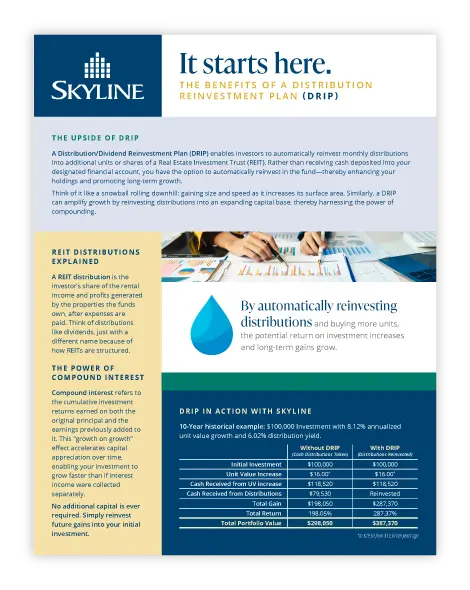
Specifically, private REITs are structured to pay out distributions regularly to investors from income generated from their properties, as applicable. As an investor, you can have those distributions deposited directly into your financial account of choice, allowing you to access the cash right away, or alternatively, you can re-invest the distributions in a Distribution Re-Investment Plan (DRIP), and harness the power of compounding dividends (or in the case of a REIT, distributions).
Essentially with a DRIP, distributions earned are re-invested to purchase more REIT units without you having to invest any more capital, effectively enhancing your holdings and your potential earnings. Those new REIT units are then able to earn their own distributions, which could then be re-invested as well, continuing the cycle and creating a snowball-growth effect on your investment’s overall value. It’s a smart way to harness the power of compounding and has the potential to turn your passive income into lasting, long-term growth.
Learn more on how re-investing distributions can boost growth; download Skyline’s free DRIP resource today:
Pick the right investment vehicle for your goals
As with all investments, choosing the right product for your goals and overall risk tolerance is the first step. Savings instruments that can help you grow your wealth with compounding interest or distributions are plentiful, but not all are structured equally, and vary in their risks and returns. You can consider non-registered investment accounts, like cash and margin accounts, as they provide the ability to make unlimited contributions (and withdrawals), but there are tax implications on capital gains that need to be considered.
Registered accounts, such as RRSPs, TFSAs, RESPs, FHSAs, LIRAs, and RRIFs, offer tax benefits and provide opportunities to grow wealth through tax-deferred or tax-free compounding. Because earnings are sheltered from immediate taxation, every re-invested dollar works harder over time, accelerating long-term growth. These accounts are generally more stable and can help protect your investments from short-term market fluctuations, though they come with contribution limits and withdrawal restrictions.
Regardless of account type, consider diversifying your investments within each account to spread risk and capture income from multiple sources. This helps maximize growth potential while maintaining stability over time.
Bottom line
Compounding interest and re-investing your distributions can unlock greater earning potential for your investments. You can maximize your prospective wealth growth by investing early, investing regularly, and investing for the long-term with compounding returns.
Skyline’s professionally managed REITs—Skyline Apartment REIT, Skyline Industrial REIT, and Skyline Retail REIT—can all harness the power of compounding interest, offering geographic diversity across multiple assets and complete professional management to give you peace of mind.
Book a complimentary meeting with a Skyline Wealth Management expert to learn how our private alternative investments can help you access compounding interest, the investment superpower.
[i] The Rule of 72 is an estimate of return on investment that is best used for demonstrating the power of compounding and quickly comparing investments. The rule uses past performance to estimate the rate, which is not a guarantee of future results, and assumes that the rate will stay stable over the full term of the investment. It also does not take into account market conditions, inflation rates, or economic performance. The Rule of 72 is most accurate when working with interest rates between 6% and 10%. For lower rates, subtract 1 from 72 for every 3 points lower than 8% (e.g. use The Rule of 71 for 5%). For higher rates, add 1 for every 3% higher than 8% (e.g. use The Rule of 73 for 11%). The Rule of 72 is no substitute for expert financial planning, research, and advice.
Compound interest and earnings FAQs
What is compound interest?
Compound interest is the cumulative amount of interest earned not only on the original principal investment made, but also on any historical earnings that have been added to that original amount.
What is the difference between simple vs. compound interest?
The difference between simple and compound interest is how the interest is earned. Simple interest is only applied to the initial amount invested and is not calculated on any distributions or earnings that have been re-invested. Compound interest is calculated on both the initial amount invested and any historical earnings that have been re-invested. This means that compound interest is a “growth on growth” earning vehicle, whereas simple interest is limited to only growing the principal amount of money invested.
How can I maximize compounding in my investments?
There are three ways to maximize your potential earnings via compounding in your investments:
- Increase compounding frequency: The more often interest is calculated during the investment lifecycle, the more often earnings can be added to your initial investment, increasing your earning potential more frequently.
- Extend time in market: The longer you invest your money for, the longer you are able to potentially earn and re-invest interest or earnings, increasing your future earning potential.
- Increase amount invested: Increasing the principal amount invested, even in small amounts, consistently over time, can exponentially increase your investment’s earning potential.
What is the difference between compounding returns in a private REIT vs. a savings account in Canada?
The two main differences are how your money grows and the tax implications of those earnings.
In your savings accounts, compound interest is calculated at a fixed, predictable rate, allowing your balance to steadily grow at that rate. Private real estate investment trusts (REITs), on the other hand, compound earnings through re-invested distributions and the long-term appreciation of the underlying real estate.
The second and biggest difference between private REITs and savings accounts is how your earnings are taxed. Generally, private REITs pay out any cash flow in regular distributions as a combination of either Return of Capital (RoC), capital gains, or other income. RoC is the most tax efficient, as any tax owed will be deferred until you redeem your investment; however, closely track your adjusted cost base (ACB) to avoid any additional tax or penalties. Capital gains are also tax efficient, given you only have to pay tax on 50% of the gain, which can be further reduced with applicable capital losses. And while other income can be taxed at your full marginal tax rate, it typically makes up the smallest portion of distributions.
With unregistered savings accounts, you will be charged your full marginal tax rate on any interest earned, making interest one of the least tax-efficient earnings types.
How often do private REIT s compound returns?
Private real estate investment trusts (REITs) generally calculate earnings on a regular basis, whether monthly, quarterly, or annually, which means that potential returns can be compounded on the same schedule by re-investing distributions. For example, Skyline REITs currently calculate and pay out any distributions monthly, which means if you enroll in the Distribution Re-Investment Plan (DRIP) that is available on each of Skyline’s REITs, you will have the opportunity to increase your principal amount and compound your earning potential on a monthly basis. Beyond this re-investment, REITs provide compounded returns with the potential long-term appreciation of the underlying real estate.
What is the best age to start investing to take advantage of compound interest in Canada?
The best age to start is immediately, regardless of where you are in your investing and wealth growth journey. Whether you’re just starting in your career or you’re reviewing your retirement wealth plan, the basics of compounding remain true: the longer your money stays invested, the more compounding periods you can benefit from, and the more you can increase your principal amount, the more opportunity you have to compound any potential earnings.
How do registered accounts work with compounding returns?
Registered accounts combine tax advantages with the potential for compounding returns, making them a potential strategic addition to your portfolio. Whether you’ve invested via your Tax-Free Savings Account (TFSA), your Registered Retirement Savings Account (RRSP), your Registered Retirement Income Fund (RRIF), or your Life Income Fund (LIF), any earnings from your investment that you re-invest into the account will receive the tax-advantaged treatment as determined by the type of registered account.
What is a DRIP ?
DRIP stands for a Dividend or Distribution Re-Investment Plan, which takes earnings from an eligible investment and re-invests them back into that account, increasing the amount invested and overall earning potential, harnessing the power of compounding.